

Two query functions
The SDK provides two functions for running GraphQL queries. Which you use depends on how your component is structured:-
useQuery()— A React hook that suspends the component while the query is in flight. Best suited for React components that render data directly. MultipleuseQuery()calls in the same component run in sequence. -
runQuery()— An async function you can call imperatively, anywhere you’dawaitaPromise. Best suited for event handlers anduseAsyncCache()definitions. MultiplerunQuery()calls within a singleuseAsyncCache()run in parallel.
Writing queries with GraphQL
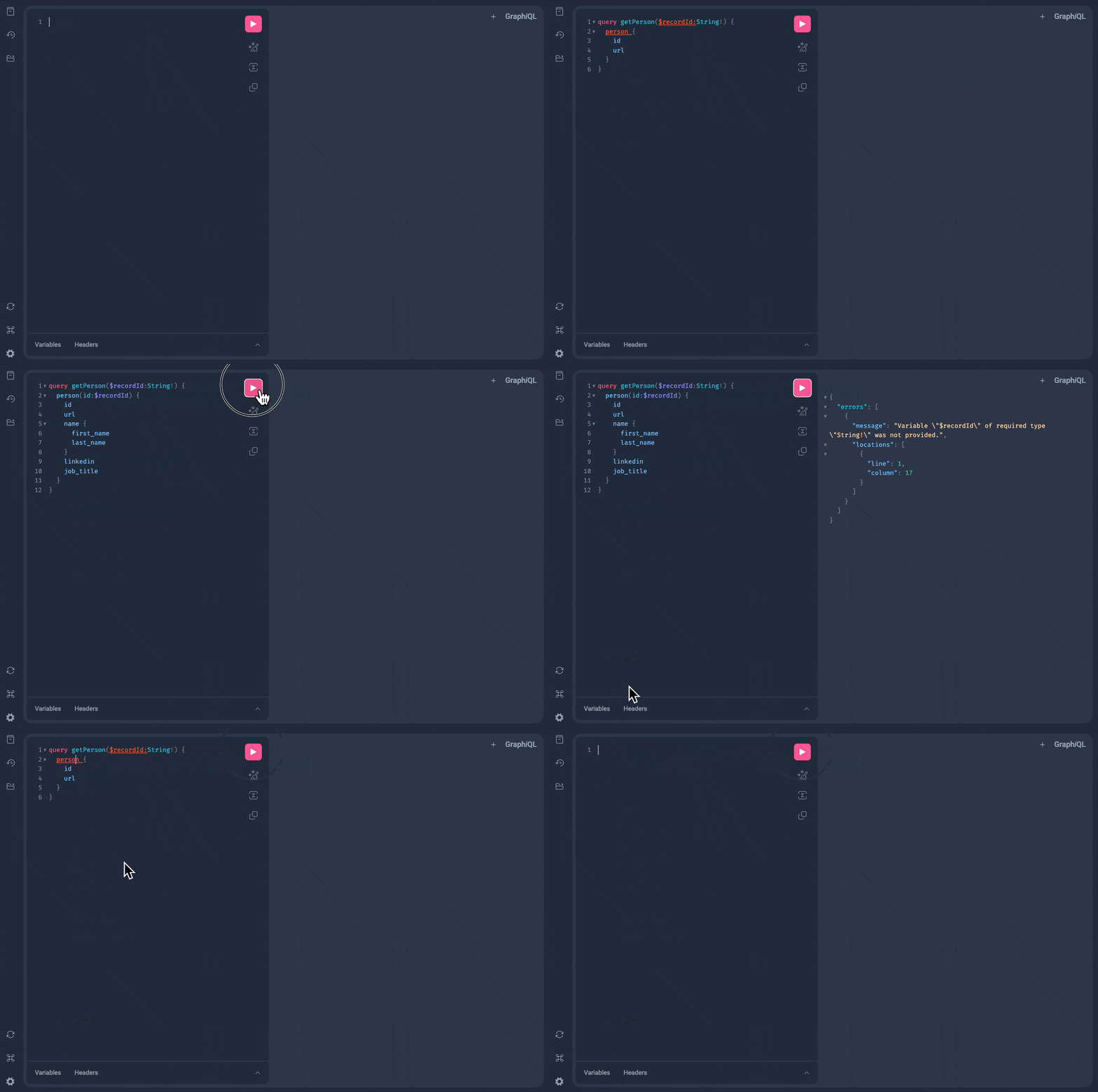
When runningnpm run dev, the development server prompts you to press o to open the GraphQL Explorer — an embedded instance of GraphQL. GraphQL lets you explore the schema and compose queries with autocompletion.
The GraphQL Explorer is useful for writing and validating queries, also the autocompletion and schema
introspection work fully. However, it is not connected to any live data source, so executing a
query returns
null unless there are validation errors.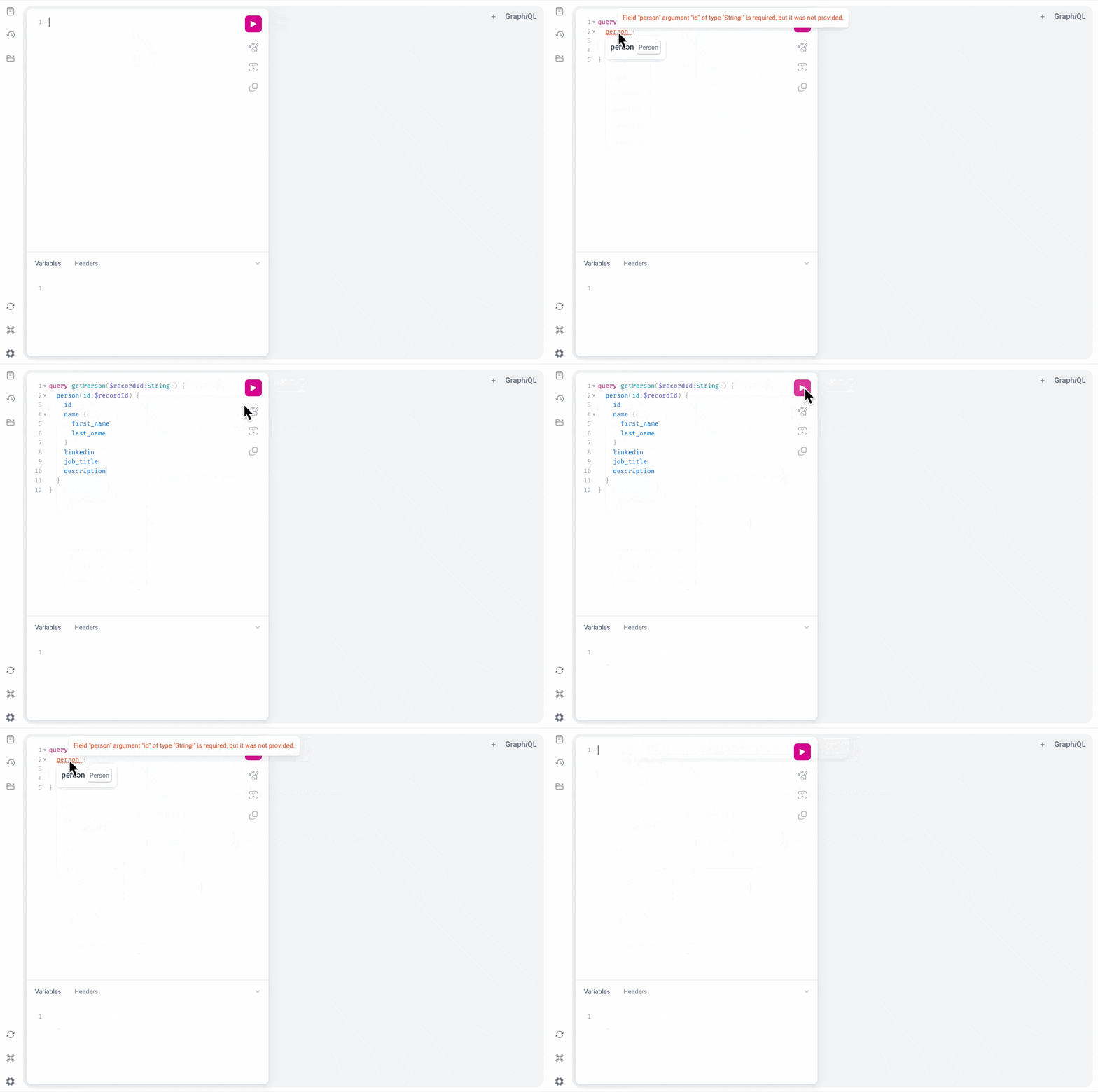
TypeScript code generation
BothrunQuery() and useQuery() accept a plain string as the query argument. However, writing your query in a .graphql or .gql file and importing it unlocks full TypeScript types on the result.
The SDK generates a .d.ts declaration file for each query file automatically while npm run dev is running. Do not edit or commit these generated files.
Custom attributes
Standard object fields are available directly by name in your query. Custom attributes — those defined in Workspace Settings — are accessed via theattribute(slug: $slug) field, using the attribute’s slug.
Find an attribute’s slug under the kebab menu for that attribute in Workspace Settings.
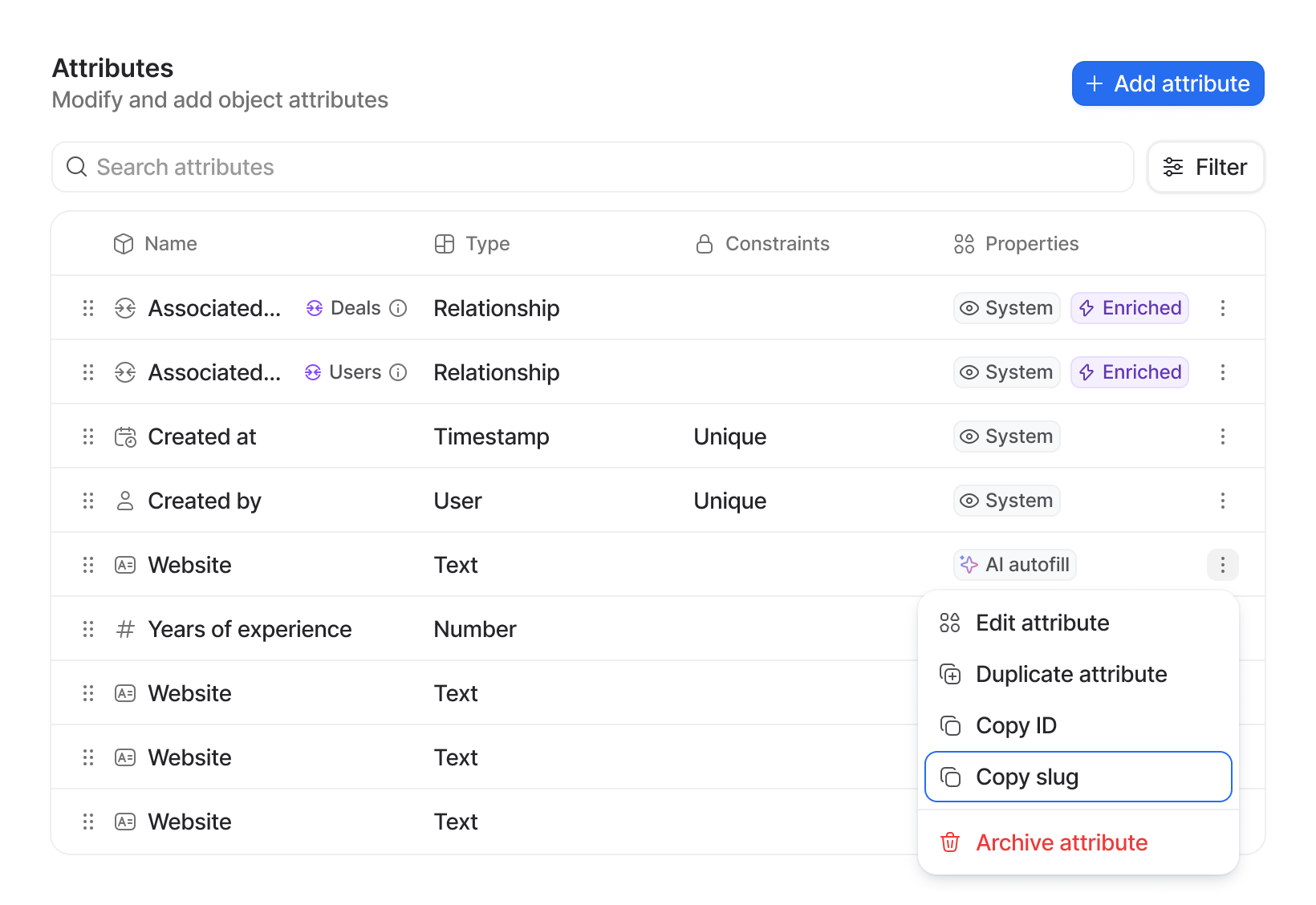
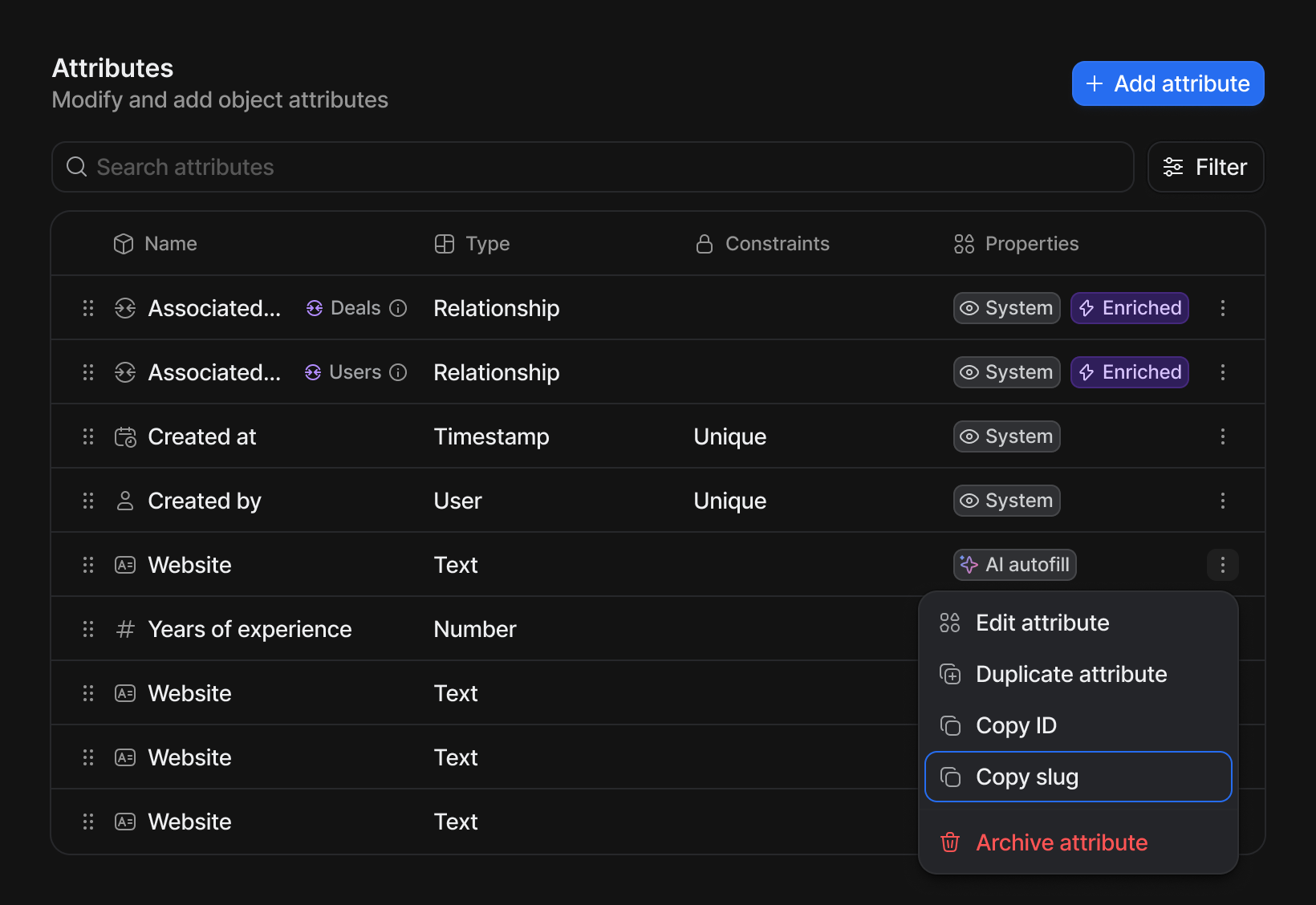 Because a custom attribute can be any type, the GraphQL schema returns a union. You must include
 __typename and an inline fragment to narrow the type before reading its value:
get-bluesky.graphql
Polymorphic results and fragments
Some queries return a union of object types. Therecord query, for example, can return a Person, Company, Deal, UserRecord, or WorkspaceRecord. GraphQL handles this with fragments: you declare type-specific fields per type, then switch on __typename at runtime.
The record query’s id and object arguments map directly to the recordId and object parameters that record action onTrigger() handlers receive.
Example queries
Get information about the current user
Get information about the current user
Get email addresses for the current person record
Get email addresses for the current person record
Get the names and email addresses of people at the current company record
Get the names and email addresses of people at the current company record